
Hi Judy,I'm a cashier in a large appliance store. I was reported to our store manager for being disrespectful to our Customer Service Department. All I did was make a request of Customer Service, and I'd like to know what's disrespectful about that and what to do about it.
Thank you!
Confused and Uncertain
====================================
Dear Confused,
Thank you for your note and question. I appreciate your quandary and admire you for wanting to do something about it. While I don't know all the details, I can make some general suggestions that might be helpful to you and others in situations like this.
1) It's what you say and how you say it.
 For example, you might have made what you believe to be a request, but for some reason your request sounded more like a demand to the receiver--who then felt disrespected. Especially if the request was made by email; it's easy to read attitude into an email. The person on the other end of the line made up a story that put you in an unfavorable light. Without you or your voice there, it's easy to make things up.
So do take a look at how the request was made. If you think it's possible the receiver misinterpreted your message, seek them out, apologize for the miscommunication and explain your more positive intent.
2) The only person you have power over is yourself.
You can't control how other people perceive or react to you. But you can decide how to think about an unexpected response.
For example, it sounds like you were surprised that someone reported you to the store manager. Instead of becoming fearful and judgmental, ask yourself this question, "I wonder why they did that? I didn't mean to be disrespectful." Then, share your curiosity with the store manager or with the person who reported you. For example, "I'm sorry you thought I was disrespectful of you and your time. I'm curious what I did or said that made you think that. Please tell me."
Starting with curiosity is a more effective way to begin a conversation. It may seem like curiosity is not a choice, but it is. You can choose your attitude, and that changes everything.
3) Read, Learn, Practice
I have a lot of teaching resources on my website (thank you for visiting!). There are many free downloadable resources on the Articles page that might be of help. And my Store offers books, CDs, and lots more.
There are many other excellent learning materials online. Check out:
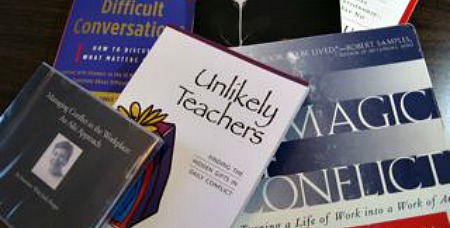
- The Magic of Conflict, Three Deep Breaths, and other wonderful resources by Thomas Crum.
- Sheila Heen and her books on Difficult Conversations and Thanks for the Feedback.
- Crucial Conversations, by the VitalSmarts authors.
Good luck, and I hope this is helpful.
Judy

Let’s discuss this post in the comments
Note: you don’t need to “log in” or “sign up” to comment. Simply enter your comment, then under the “sign up with Disqus” field enter your name. Then enter your email address and click the checkbox (that will appear) with the label “I’d rather comment as a guest.”